Showing posts with label teenagers. Show all posts

Friday, October 7, 2011

And yet it redeems itself . . .

So last post, one of the books that disappointed me was the 3rd book in the Ember series by Jeanne DuPrau.
Fortunately, the other 3 books in the 4 book series were pretty good.

The first, The City of Ember, chronicles the problem of a city built deep underground.  As the generator that keeps the city alive threatens to die for good, 2 young teens, Doon and Lina, take it upon themselves to find a way out of Ember.  And they do!
In The People of Sparks, the Emberites make it aboveground, only to find that there is almost nothing left.   Society was destroyed at the time that the original people of Ember were led underground.  Of the few villages left, Sparks is one of the best surviving and takes the Emberites in.  This 2nd book chronicles the problems that arise.

Skip the third book.  Seriously.

The 4th book, The Diamond of Darkhold, 
has Lina and Doon traveling back to Ember to find something to help their villages and save them all from starvation.  What they find is something the "builders" left for them long ago that does indeed help them and also spur them back into creating a more "modern" civilization again.

If you ignore the reference to aliens at the very end of the last book, these are really good.  They're clean, they're interesting, and I think my favorite part about them was that they are realistic.  

Many "end of the world" books are all doom and gloom.  And when the world finally does end -- that's it.  We don't know what happens next.  DuPrau instead has the end of the world already over.  These books are about after -- survival, humanity, and hope.  I really enjoyed the feeling that it's not a scary thing to start over. Hard yes, confusing certainly, but not scary.

And I love her insights into things.  I think my favorite lines from all 4 of the books were these:  "And yet, she reminded herself, look at all the remarkable things she and Doon have done!  It wasn't because they had extraordinary powers, really, but because of how well they used the ordinary powers everyone had: the power of courage, the power of kindness, the powers of curiosity and knowledge."

And I thought -- that is what I want to teach my children.  To be courageous, kind, curious, and knowledgeable.  And if more children were taught these things, the world WOULD be a better place.

Read these books -- they're worth it.

Wednesday, September 14, 2011

A Bevy of Books

bevy (noun): 1. a group of birds, as larks or quail, or animals, as roebuck, in close association.  2.  a large group or collection.

I didn't know definition number 1 -- and now I have to look up roebuck.  But I love the word "bevy" and although the books I'm talking about today probably don't quite constitute a bevy, I wanted to do them all in one post rather than break them up.  For no good reason.

So I've read two books about thieves and they were both good, but also a little odd.
Cornelia Funke is also the author of the trilogy Inkheart, Inkspell, and Inkdeath which are good in and of themselves.  Apparently she is very popular in Europe, particularly in Germany.  For The Thief Lord her setting is Venice, Italy.  And although it could probably fit in the realm of fantasy -- there is very little fantasy about it.

The main story centers around a pair of young boys who have run away from their aunt and teamed up with several other youngsters (wow I sound old -- I couldn't get a better word there though) to survive on the streets.  Although for street survival, they are a good and honest bunch.  Throw in a detective, an eccentric photographer, and a merry-go-round, and you have an easy to read, slightly strange, young adult novel with a message at the end (ok maybe not -- the English teacher in me reads a message!).  It was quick, it was interesting, it WASN'T my favorite of hers, but it was good.  Don't I sound cryptic?  It gets worse.

So this second book:
The Book Thief by Markus Zusak has won several book awards.  That's why I initially picked it up -- I didn't know anyone who had already read it.  It is a World War II story that revolves around a young German girl and the Jewish man her family hides in the basement.  But it is about so much more than that.  The story is told by Death himself and the style was very different to me.  He jumps ahead and then goes back to clarify, he interrupts his own story to summarize rather than show.  I didn't have a hard time following the storyline at all, it just was different to read.

Honestly, it started slow for me and I had to keep reading through almost the first 1/2 of the book.  But then I got really hooked and attached to the characters and when the book ended, I wanted to know more about what they had done with their lives.  I wanted a Christmas letter.

But I didn't get it.  I cried a few times and I kind've laughed  But this really was the type of book that afterwards I wanted to sit down and discuss it with a group.  Or even a class.  Because even a class of high-schools would find plenty to discuss -- some difficult and abstract -- some pretty obvious.  It's a great book for schools.  Too bad most schools will never see it.  Oh yeah, the language is atrocious by the way.  And that's probably one of the reasons schools will never see it.  Which is a shame -- I think kids would really drink it in.

Last but not least -- last week for our playgroup was the letter "Q" so of course we had to go royal and talk about queens.  The Queen of France by Tim Wadham
is ridiculously cute.  Rose has an imagination about the size of France and feels "royal" for the day.  I loved that because it reminds me of my own little princess running around.  I also loved how her parents reacted to her and I loved the illustrations.  They are so oddly normal.

Another "children's book" that I actually learned something from is When Royals Wore Ruffles.
This is a very delightful alphabet book about fashion.  I learned the names of those pointy princess hats (which I can't remember and the book is in my 3-year old's room where she is sleeping and I don't dare go in there!), great stuff about corsets, bustles, high hair, even modern-day fashions.  Really fun.  My only beef?  I hate the illustrations!!  I think you could have really gone to town with this and done elaborate, awesome illustrations interspersed with actual pictures.  But no, they are what you see there above -- kind've crayon-y if you ask me.  Disappointing.  But awesome for the info.

And that's my bevy for today.

Tuesday, May 31, 2011

So You Like Detective Novels?

I remember when I was younger that I went through a big Bobbsey Twins and Nancy Drew phase.  Remember them?  I don't know if they would take off now though.  In fact, I think there was a Nancy Drew movie a while back that flopped pretty badly.

But that doesn't mean that the children's detective novel has died.  Nope.  It's been revived in the form of The Brixton Brothers and the Case of the Case of Mistaken Identity by Mac Burnett.
I picked this up at my library because it had won Texas' Bluebonnet award (more on that later this week) and I love young adult literature so, why not?  Ah it brought back memories . . . 

In a good way.  The protagonist -- Steve -- is an 11-year old die-hard fan of a detective series similar to The Hardy Boys.  He's read all their books.  And he has their detectives handbook.  Which actually gets him into more trouble since the whole thing is tongue-in-cheek and he just doesn't get it.

Although Steve WANTS to be a detective, he finds out what it's "really" like when he's mistaken for one by both the good guys (librarians who are really an ultra-secret protection agency -- very cool) and the bad guys (a ring of villians led by Mr. E (get it?) who is looking for a top-secret quilt with all of America's secrets stitched on it -- awesome!).

This is your classic kids detective book but as an adult I loved it for 3 reasons:
1.  The librarians.  Who knew that they were even better-trained and deadlier than the CIA?  Their weak spot?  Searching a library for their suspect, they are easily distracted by books that have been mis-shelved!
2.  The quilt.  Just because I love quilts and quilting and I found it truly hilarious that it was the hiding place of all our secrets.
3.  The humor.  Steve takes everything so seriously.  For example, when he's tied up, he flexes his muscles because that's what his detective handbook says to do.  Then the ropes will just fall right off when he relaxes.  Of course he discovers that's not exactly the case . . . and I love when he figures out what a magnifying glass is good for (you'll have to read it).  There is so much irony and sarcasm to this book -- it was great!

Oh yeah, and it's totally clean.
Love that.

I highly highly recommend as a great light, funny read.

Wednesday, April 20, 2011

Poetry for Teenagers . . . Yes, I'm serious!

Technically, this also covers another one of those poetry bits and pieces.

Narrative Poetry: A poem that tells a story.

In my days as a teacher I ran into plenty of enthusiasts for Edgar Allan Poe's poetry -- especially "Annabel Lee" and "The Raven".  But book-length narrative poems are few and far between.  You could go back and dig up Elizabeth Barrett Browning's Aurora Leigh.  But it probably won't get your teen excited.

I think I have a solution.  Two actually.
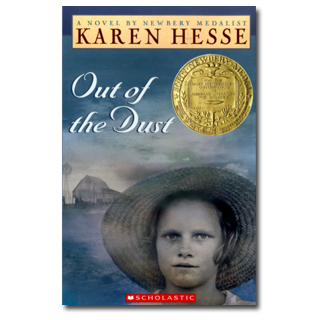
Karen Hesse, Out of the Dust is a fabulous story told from the point of view of a teenage girl living in the Oklahoma panhandle during the Great Depression and in the middle of the Dust Bowl.

But despite the despair that the story begins in, and continues in, there is hope at the end of the tunnel.  And in these economic times, I found that reading it again was inspiring in way.

The story is told in poetry -- but you hardly notice it.  And that's the key to good narrative poetry.  Well, good poetry at all.  It flows so much that you simply read and soak it in.  But it also has moments where as you read you see how the form and the technique of the written poem adds to the feeling that is created.

My favorite poems (but you can't read them out of the context of the novel now!) are "The Accident", "Hope", and "The Dream".  But they're all good.  Hey, they make me cry.  Ok that's not necessarily a mark of genius -- I'm a fairly leaky person!

Secondly, if you want something for that middle school crowd, and boys-who-don't-like-poetry especially, Sharon Creech's Love That Dog is a cute read, perfect for National Poetry Month.
Take a look at her site on the book because she not only talks about the book but about the inspiration behind it in a poem from Walter Dean Myers.

And then I will say this -- the main character is a boy and he expresses a typical boy's interest in poetry in the beginning of the book.  His voice is so clear that I can practically hear this kid sitting in my classroom complaining about poetry!  Also, he references several well-known poems that I think would be great to read with the book and have kids respond to them as well.  But he comes around.  As I wish they all would!  It's a fun fun read -- particularly for me as a teacher.  But it is really easy to relate to -- especially to kids who don't like poetry (and unfortunately, that seems to be most of them!).

Those are my favorites for narrative poetry.  Oh, and another thing to entice your teenager with?  They're short.  Enjoy!