Showing posts with label teaching. Show all posts

Wednesday, September 21, 2011

An Exploration of Government

I just reread a "trilogy" of the books where the first one is often taught to middle school students.  But there's the reason for rereading -- after finishing all three right in a row I had some major ideas that I wish I had had when I taught the actual books.  Maybe someday I can go back and use this!

The "trilogy" is by Lois Lowry.  The first and second books are companion books (that's why there are quotes around trilogy) and then the third book finishes the other two and brings them together.  In order they are: The Giver, Gathering Blue, Messenger.


Of the three, you can ignore Messenger.  Isn't that terrible?  Unless you want to see what happens.  But I thought that Lowry had some fantastic ideas and the plot was very interesting and then the ending just was a cop out -- a kind've I-don't-know-how-else-to-resolve-this-so-I'll-just-do-it-quick kind've thing.  I was really disappointed.

But the other two.  Oh my.

So both The Giver and Gathering Blue are set in the future and feature very different societies from ours.  The Giver's society is more advanced in many ways but has worked to create a state of "sameness" -- total equality and no differences.  In Gathering Blue, the society has regressed to more primitive times and there is a great disparity among the people and the small group that controls and rules over them.

The books are geared towards middle school readers but I decided that it would be particularly fascinating to read them either with students who were studying the formation of American government or who were studying the workings of governments in general.  Why do we separate literature from everything else?  I think that you could have some fascinating conversations with high-schoolers about these societies and how they mirror or own --and how they don't.  In fact, there are some key points to explore and questions to raise in the teaching.

1.  Both societies have a ruling group that controls the people's access to knowledge.  How is that reflected in our society today?  How difficult would it be to take what we have currently and impose the society the exists in the books.  
2.  What do you think were the original intentions of the founders/creators of each society?  In what ways does it appear that those intentions have been warped? (This is a particularly interesting question with all the debate NOW about our founding fathers and the government they intended to create vs. what we have and where it's going.)
3.  Both books feature a main character that has been singled out due to a specific talent or gift.  How do we celebrate or hinder those with gifts in our society?  What gifts or talents are honored in our society?
4.  In The Giver, the main character leaves his society in order to change it.  In Gathering Blue, the main character stays in order to do the same thing.  Compare and contrast these decisions.  What kinds of problems might we face today that need similar reactions?

If I were teaching this today, I would start the kids reading the books before we even talked about government.  They're short, easy reads so it wouldn't take long I think but I would read them one at a time and discuss them individually before approaching them together and in conjunction with modern day government.  In my head, I believe that students would find this approach to government relevant and interesting.  In reality, I know that's always up in the air.  But it's worth a shot.

Wednesday, August 3, 2011

Teach Geography

There was an article in our Dallas newspaper that reported that the latest testing of students in GEOGRAPHY found that only 20% of high school seniors are proficient or better and that it's not much better for eighth-graders at 27% and 21% of fourth-graders.

Wow.  That's pretty bad.

I have my own theories on this (which soap box I will not subject you to at the moment), but also thought that there must be simple ways to support the learning of geography at home.

Display a map of the world and a map of the United States in your home: kids love learning about places that are different.  How simple it would be to talk about the world on a regular basis if you have something up to start the conversation.  Even better, get the giant maps and then find pictures of landmarks, animals, people (especially family members) and put them on the map.  Give your children a sense where things are and how they connect to them.

There are blank outline maps for the United States and individual states located here.  They can be used for coloring or "building" the United States as you learn U.S. history - which states came first and how did the United States look at various stages of history.

Start a postcard photo album.  Every time you travel get a few post cards of that place and start a picture album to display them.  If you have family in various places or who travel a lot, enlist them to send some to you.  Every kid loves to get their own mail and when it's a cool picture of somewhere great it's even better!

Celebrate diversity by trying different foods.  That doesn't have to involve special grocery trips or even a lot of cooking.  If you like in a larger city there are always restaurants for different types of food but more and more the grocery stores carry basics that are staples to different cultures.

Find old copies of National Geographic and create world collages out of them.  Our local library has a for sale book nook that ALWAYS has old copies for 10 cents each!  And their pictures are always fantastic and go all over the world.  

And if all else fails, find The Animaniacs on YouTube because they sing the 50 states and nations of the world (which I'm sure is outdated by now), and even my 3-year old loves them.

Monday, August 1, 2011

For Traveling

A friend of mine had this fantastic idea for long trips that I thought I'd pass along.  It would work best with elementary school-age children, although I plan to use it with my 3-year old the next time we go across states because she loves to color.

If you're not familiar with it already, Crayola has a website with coloring pages, crafts, and lesson plans.
If you click on coloring pages on the left-hand side and then on "learning", they have a category for states.

Print a sheet off for every state that you will drive through.  When you get to that state, give your child the coloring page.  They have the state flag and then birds, animals, flowers, etc. that are the "official" whatever for that state.  

Not only does your child get something new to do, it marks your movement to your destination and gives you something to talk about.

There are also categories for landmarks, geography, and places and of course they have pages with Disney characters, holidays, seasons, sports, etc.

Friday, July 22, 2011

Founding Fathers Lesson Plan

Ok this is less of a lesson plan and more of an assignment actually.  But the idea occurred to me after the 4th of July when I read John, Paul, George, and Ben by Lane Smith again.
The most common complaint I hear from people who don't like history is that it's boring.  That is a such a shame!  Our history (United States, world, whatever) is full of awesome stories that need to be told!  I think that history teaching CAN rely on too much straight-up information and ignore the human aspect.

That's one reason I love this book: it gives human characteristics to some founding fathers in portraying them as young children with traits that translate into what they did as adults (Paul Revere shouting in his family's shop about giant underwear is hilarious but then he did shout "the redcoats are coming").

So why not make all the founding fathers approachable?

Assign each student in your class (or if you homeschool go through the founding fathers together one by one) a different founder.  Have them find out about that founder and then make up a funny story about them as a child that reflects that trait.  

For example:
The Book of the Founding Fathersby Vincent Wilson, Jr. provides a brief biography and pictures for 35 founding fathers -- famous or otherwise.

Richard Henry Lee of Virginia was a wealthy planter who denounced slavery and was one of the first to organize the boycott of British goods once the Stamp Act was passed.  Blah blah blah right?  But how does that trait translate to childhood?  You could come up with a funny story about how Lee boycotted the neighbor boy's lemonade stand because the sugar was from the West Indies or perhaps he runs around as a little boy organizing protests against common childhood rules such as washing behind your ears or not staying out after dark.

I think it would help kids remember the idea behind what various founding fathers did for this nation in it's beginning.

And it could be really funny.

Monday, July 18, 2011

Our Founding Fathers: George Washington

A friend of mine is starting some American history kindergarten curriculum for her son this coming fall and was looking for ideas.  Browsing in the library one day, I came across this book and decided it would be a great learning tool:
George Washington's Teeth by Deborah Chandra

This delightful book is told in rhyme and is the story of George Washington's teeth and their loss.  Almost everyone knows some kind of story about Washington and his teeth, but I tell you what -- I learned something!

After the story is finished, there is a timeline of events for Washington's life that is taken from his own letters, diaries, and accounts.  And there is quite a bit about losing his teeth, teeth pain, or calling the dentist (which at that time pretty much meant removal).  In fact, did you know that the famous Gilbert Stuart portrait of Washington included padding in his face because of lack of teeth?  I had to laugh at that one -- I would think that a painter could just paint as if they were there!

The whole timeline is actually very fascinating and would make a great jumping off point for talking about Washington's contributions to American history as it spans from his birth until death.  For kindergartners, it would also be fun to keep track of how he loses his teeth and count them down.

Actually, I wished that I had had this book to read to my 9th graders.  Even they love a good story and all that "gee whiz" information.  In fact, a lot of times they prefer that to major historical events!

Wednesday, June 29, 2011

On Writing and English Classes

Remember my rant about wanting to pick writer's brains?  Well I found a book that has done that.  I haven't read it all yet but I wanted to share a few things.
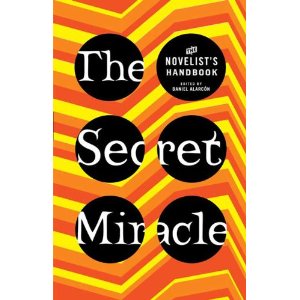
The authors "interviewed" in Daniel Alarcon's The Secret Miracle are mostly foreign, but a writer is a writer!  The book is a compilation of some panel interviews conducted by the author and simply consists of questions and each author's answer.  The chapters are organized to reflect basically different parts of the writing process: influences, starting, plot, character, scene etc., revision, and finishing.

I'm mostly skimming right now but loved this answer from Santiago Roncagliolo in response to the question: "How many books do you read in a given month?  How many books do you read at a time?"

"If I don't like one, I abandon it and I begin another.  There are lots of good books to be read.  There's no need to obsess yourself with the bad ones.  There are also good books that you read at the wrong time.  In those cases, it's better to wait and try again later."

I could not have said this better myself!  He is so right and that of course leads directly into my biggest soapbox:  English classes in high school.
(I'll try to be brief and concise here, otherwise we could be a while.)

With 5 years of English teaching experience across a broad spectrum of "abilities" and desires, I've come to the conclusion that 4 years of English classes reading "classic" literature is a waste for most students.  I, personally, love classic literature and yet there are certain authors that I DO NOT READ FOR FUN:  Nathaniel Hawthorne and John Steinbeck are just two.  So yes people, the smart thing here is to require it of teenage boys and girls who are planning to spend their lives in construction, as math teachers, as scientists or doctors, working at Walmart, or painting, or whatever!  (Please read heavy sarcasm here).  

Education should be focused on teaching students to read and write well and should use a variety of tools to do that.  If that means you dig out Captain Underpants then so be it.  The tools will lead them to greater success than the actual book.

That being said, I do have books that I have put aside only to love them later.  A good example of that is Charles Dickens' Hard Times.  Love that book.  Love love love that book.  But I didn't love it until college.
And my grandmother often sends me books with a note that she didn't like it and stopped reading but here you go anyway.  Although we have similar taste, there's a few that I have loved that she hasn't been able to get through.

That's what makes a blog like this problematic.  I can recommend books, but that doesn't guarantee that YOU will like them.  And that's ok!

I'll still love you.

Monday, June 27, 2011

A New Kind of Poetry

I completely forgot that I was going to blog about this.  But better late than never!

There was an article in our Dallas Sunday newspaper a few weeks back about a gentleman by the name of Austin Kleon.  He has just published a book of poetry using a method he more or less invented called "newspaper blackout".  

The premise?  Take a newspaper articles, column, advertisement, whatever -- and black out all the words except for those that make a poem.

He blogs about it and posts his poems here.  It's actually really neat!

Ok I'm downplaying it -- I think it's really cool!  Yet another idea to make me jealous.  After all, what a great way to get students to create poetry.  So often it's hard to come up with the words, but when they're already there for you . . . but you're looking for poetry really.

I can't use this until the girls are older unfortunately but IF YOU TEACH ENGLISH SOMEWHERE OUT THERE, you really should check this out.  I might just have to try it myself as well.

Where did today's newspaper go . . . 

Wednesday, June 1, 2011

Learning about the President

Teaching 9th grade American history, I really enjoyed teaching kids about how our government works: the three branches of government and their roles mainly.  But sometimes they had a hard time relating to or understanding what exactly each role does.  Understandable.  Government is a complex issue.  Just recently I found a great book to help school kids understand a little better the role of the President.

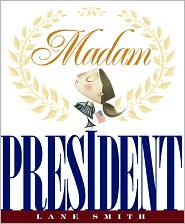
Madam President by Lane Smith is a funny, clear-cut look at the life of the president.  But the president in the book is a young girl who simply exercises her authority in her own life

The book reads well, the illustrations add an explanatory element (that opens up discussion), and it's funny.  Check out the "list" of all of her cabinets -- they correspond with the toys available to fill the position.

My 3-year old enjoyed it as a story and I found myself wishing she were school-age and learning about this stuff so that we could talk about it more, not just read it.

But that will come.  And then it will be back to the library to check this out again!