Showing posts with label writing. Show all posts

Wednesday, June 29, 2011

On Writing and English Classes

Remember my rant about wanting to pick writer's brains?  Well I found a book that has done that.  I haven't read it all yet but I wanted to share a few things.
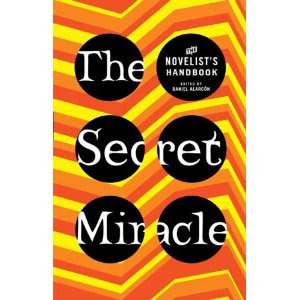
The authors "interviewed" in Daniel Alarcon's The Secret Miracle are mostly foreign, but a writer is a writer!  The book is a compilation of some panel interviews conducted by the author and simply consists of questions and each author's answer.  The chapters are organized to reflect basically different parts of the writing process: influences, starting, plot, character, scene etc., revision, and finishing.

I'm mostly skimming right now but loved this answer from Santiago Roncagliolo in response to the question: "How many books do you read in a given month?  How many books do you read at a time?"

"If I don't like one, I abandon it and I begin another.  There are lots of good books to be read.  There's no need to obsess yourself with the bad ones.  There are also good books that you read at the wrong time.  In those cases, it's better to wait and try again later."

I could not have said this better myself!  He is so right and that of course leads directly into my biggest soapbox:  English classes in high school.
(I'll try to be brief and concise here, otherwise we could be a while.)

With 5 years of English teaching experience across a broad spectrum of "abilities" and desires, I've come to the conclusion that 4 years of English classes reading "classic" literature is a waste for most students.  I, personally, love classic literature and yet there are certain authors that I DO NOT READ FOR FUN:  Nathaniel Hawthorne and John Steinbeck are just two.  So yes people, the smart thing here is to require it of teenage boys and girls who are planning to spend their lives in construction, as math teachers, as scientists or doctors, working at Walmart, or painting, or whatever!  (Please read heavy sarcasm here).  

Education should be focused on teaching students to read and write well and should use a variety of tools to do that.  If that means you dig out Captain Underpants then so be it.  The tools will lead them to greater success than the actual book.

That being said, I do have books that I have put aside only to love them later.  A good example of that is Charles Dickens' Hard Times.  Love that book.  Love love love that book.  But I didn't love it until college.
And my grandmother often sends me books with a note that she didn't like it and stopped reading but here you go anyway.  Although we have similar taste, there's a few that I have loved that she hasn't been able to get through.

That's what makes a blog like this problematic.  I can recommend books, but that doesn't guarantee that YOU will like them.  And that's ok!

I'll still love you.

Tuesday, June 28, 2011

Blackout Poetry Attempted

That was harder than it looks.

I sat down last night watching reruns of The Closer and Bones and picked up our newspaper to try blackout poetry.  I picked the "Arts and Life" section thinking there would be better words.  And there were great ones!  But it was actually really hard!

Once I got started, then I wanted the poem to go somewhere that I just didn't have a the words for.  I had to look at the article and think about how the words would work outside of what my vision was.  It was definitely an exercise in thinking outside the box!

So this is my poem:  It's hard to see but what it says is -- art this fascinating cultural masterpiece ties the world over the years, to the present

Sounds more like a wise saying than a poem to me (I gravitate towards more traditional poems myself) but it works!

Monday, June 27, 2011

A New Kind of Poetry

I completely forgot that I was going to blog about this.  But better late than never!

There was an article in our Dallas Sunday newspaper a few weeks back about a gentleman by the name of Austin Kleon.  He has just published a book of poetry using a method he more or less invented called "newspaper blackout".  

The premise?  Take a newspaper articles, column, advertisement, whatever -- and black out all the words except for those that make a poem.

He blogs about it and posts his poems here.  It's actually really neat!

Ok I'm downplaying it -- I think it's really cool!  Yet another idea to make me jealous.  After all, what a great way to get students to create poetry.  So often it's hard to come up with the words, but when they're already there for you . . . but you're looking for poetry really.

I can't use this until the girls are older unfortunately but IF YOU TEACH ENGLISH SOMEWHERE OUT THERE, you really should check this out.  I might just have to try it myself as well.

Where did today's newspaper go . . . 

Friday, June 24, 2011

On Writing

I am a reader.

I have been since I was very young.  I've always preferred reading to pretty much every other activity out there.  So when I say that I've been sucked in to a book that means nothing else gets done.  Which is a little more complicated now that I'm a mom of course, but it still happens.

But am I a writer?

I can't decide.  I'm not one of those who has made up stories my whole life.  I've been content to read others.  But that doesn't mean I couldn't be a writer I think.  And I've had some ideas here or there that might be interesting to read if I could get it down on paper fluidly.  I just don't know.

When you hear writers talk about their work, they always talk about how difficult it is to write.  But the thing is, they don't really go into detail.  I would love to KNOW how Rick Riordan gets his ideas for his books.  What happens when he's stumped?  How does he connect events to make a whole cohesive story?  I would love to pick Shannon Hale's brain about character.  How do you make each character endearing and have a real voice?  How do you write them so that they come alive?  I want to ask Richard Peck how to write humor and create situations that make me laugh out loud (because they do).  And I want to ask them all about process.  How does a book go from an idea to a finished product?  All I get to see is the finished product -- what does it look like in the meantime?

But I can't.  So I guess I have to experiment myself.

I wrote a first draft of a children's book about 2 or 3 weeks ago.  And this is how it went -- had the idea, sat down at the computer, wrote the entire book in one sitting visualizing what it would actually look like as I went.
Then I sent it to some friends and family for feedback.  First draft.  I didn't hear back from most of them and there may be several reasons for that but I can't help but wonder if it falls under the old adage: "if you can't say something nice, don't say anything at all."  Because I'm self-conscious.

So now I'm going to do my second draft.  I haven't decided how yet: print off the original and retype the whole thing or just fix bits and pieces on the computer.  I don't really know what my process is, it's been so long since I've written fiction (since college actually).  But I'm going to try and see what happens.

Oh and just to document it as I go, I've also begun a young adult novel.  That has been a bear.  I have lots of ideas floating in my brain but no clue on how to make them connect or be exciting to read.  So I just type as I think of things and maybe I'll try connecting the dots later!